LEARNING TO THINK
AUTOMATED THINKING
Thinking starts with a problem to solve or a goal to achieve.
If our problem is that we’re hungry and our goal is to make scrambled eggs, we start by thinking of the order in which things need to happen. This is the sequence of steps we follow in a recipe to make our scrambled eggs. While we are doing each step we are also thinking.
1. Check if you have the ingredients and equipment
Thinking while doing: I have three eggs left in the fridge, will this be enough? (Planning) I don’t have pepper so I’ll leave it out.
2. Crack the eggs into a bowl
Thinking while doing: Is the bowl deep enough to allow for whisking? Don’t crack the eggs too hard or the shells will fly into the bowl (Control the force exerted in your hand when cracking the egg). Monitor whether the eggs are cracking cleanly and adjust your grip accordingly. (Monitoring)
3. Beat the eggs
Thinking while doing: The yolks are breaking but theres no consistency (Sub-problem). Should I add milk to make it more fluffy? (Sub-Solution)
4.. Put the stove on and heat the pan
Thinking while doing: Check if the heat is too high? (Monitoring). If the heat is too high then drop the flame (Sub-solution)
While we are doing, if a condition exists (i.e the heat is too high), then we take an action i.e. reduce the heat so the eggs dont stick to the pan.
So thinking can be seen as involving two levels:
Firstly an overall order in which things need to happen.
Secondly a thinking in doing phase where we ask ourselves a series of questions as we are doing things and adjust accordingly.
By thinking aloud and transcribing our thinking process, we can identify our procedure for thinking and areas that can be improved can help us achieve better results by rewriting our code or our thinking scripts of the mind. Computer are essentially big calculators that understand different sequences of 0’s and 1’s to form binary code which represent letters and words. In the same way, the the basic units of thinking code are human readable letters and words which can manifest as the voice in our heads. For some people this voice in our head can vocalizes thoughts or images or experiences where we replay scenarios in our minds eye. For other people, these thoughts are visualised through images and experiences.
CONSCIOUS THINKING
The tools of the thinker include asking the three questions: WHAT, WHY AND HOW?
Thinking tools include looking for causes and effects in a scenario, building narratives and an explainable, logical sequence of events.
Critical Thinking is a way of asking questions in order to find out the truth of something. It examines something from different perspectives. reasons from evidence and looks for gaps in the argument in order to arrive at a conclusion. Logic involves things making sense particularly in relation to placing things or events one after the other resulting in consequences. We can apply a logical sequence to a problem by developing a storyline of actions and consequences that could unfold as a result. Negative consequences or effects that don’t achieve the goal result in poor logic. Decisions involve weighing up the benefits and drawbacks of an action concluding by choosing the action with the best outcome.
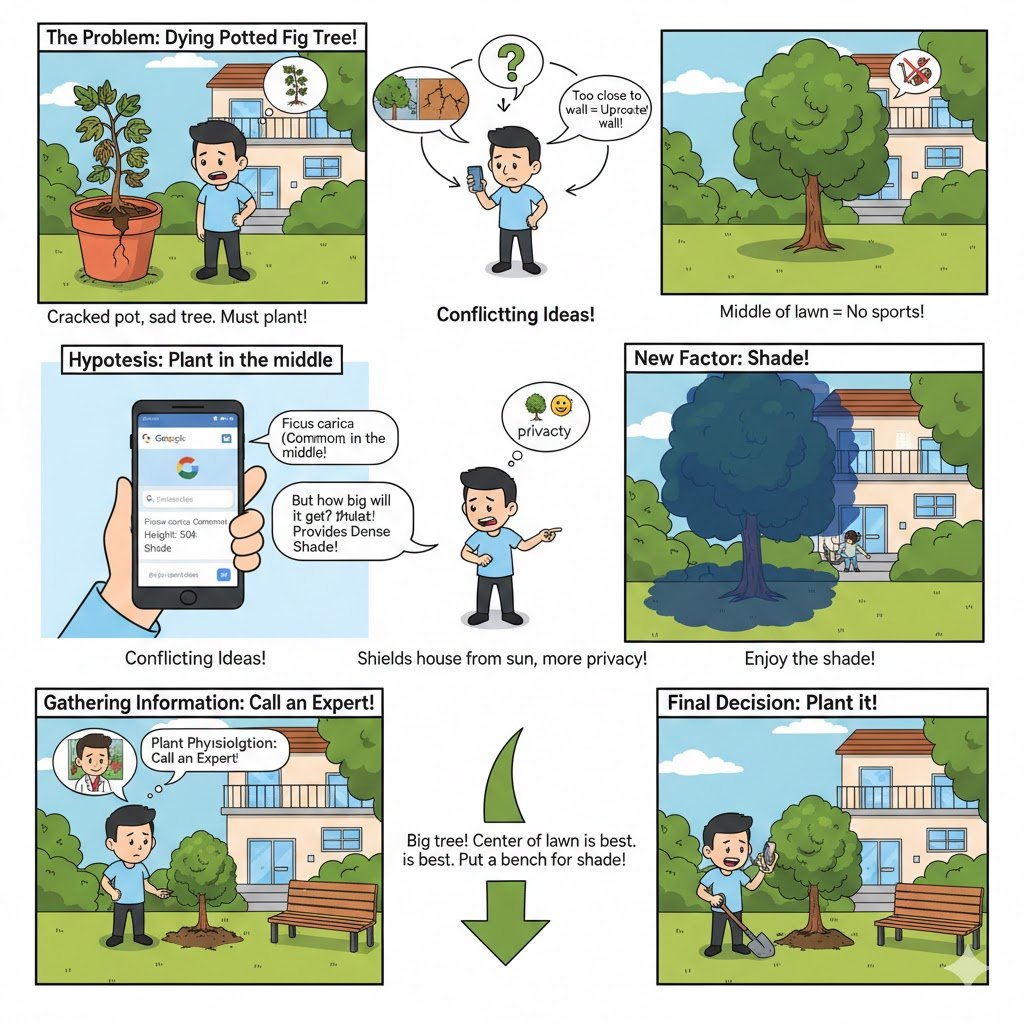
Lets say you face the problem of where to plan a fig tree on your lawn.
Problem: The tree was previously potted, the pot has cracked and the tree is starting to die
Initial Solution: Lets plant the tree
Main Question: So where do we plant the tree?
Factors to Consider and Simulation of Consequences
If we plant the tree to close to the wall, the roots will uproot the wall (Factors to consider and Simulation of consequences).
If we plant the tree in the middle of the lawn then we cant use the lawn for playing sports like golf or football (simulate consequences). Based on these conflicting views we forego the use of the lawn for sports and put forward a hypothesis that the tree should be planted in the middle of the lawn (hypothesis and sub-decision).
However we dont know how big this tree will grow in future. So we take a photo of the tree and search for the type of tree and more information about how large it grows on Google Lens (collect evidence). This tells us the tree will grow 50 - 90 feet in height and provide lots of shade.
Now another factor arises in making the decision about how the shade provided by the tree will affect the house located about 10 metres away (Factor to consider). The tree could shield the house from midday sun and also provide more privacy to householders using the overlooking balcony (simulate consequences).
Call an Expert
We cannot make a decision so we decide to phone an expert plant physiologist and send him a photo of the tree and where we hope to plant it (gather information). The expert says the tree will grow big and therefore needs to be planted in the centre of the lawn and will be good for placing a bench underneath to enjoy the shade on a hot day.
Final Decision: Plant the tree in the centre of the lawn
In the above scenario, critical thinking, logic and decision-making is used to make the final decision on where the tree should be planted.
Te seen as procedure Ways to visualize thinking steps include think alouds to identify the thoughts and flow charts and storyboards to visualise the steps in thinking. The storyboard illustrating the thinking process for deciding where to plant the tree would like this as an example:
If thinking can be looked as a procedure of steps, we can visualize these steps through thinking aloud and using coding and thematic analysis to label each step. Then we can develop a storyboard or flowchart to illustrate the steps. Then by identifying and evaluating the sequence of steps, we can improve and adapt our thinking procedure. By continually practising this procedure and adapting it we can improve our thinking.