If I use writing to put my thoughts down on paper, at its most basic level, an essay is an illustration of my thinking process about a topic. It shows how I understand the context that a topic occurs within, how I define the concepts and understand the relationship between things. I look at the literature written about it to build a larger framework of concepts in hierarchical fashion (almost like a contents page of a book) that provides the theoretical structure I need to cover to develop a deeper understanding. As I read I critique other authors looking for holes in their argument and the take my own position with reason and evidence to support my view. The one main idea in each paragraph of the essay that I want to get across to the reader (often expressed in a 5-7 words) can be linked to the main idea in subsequent paragraphs to develop a line of reasoning. When taking a zoomed out view, the structural writing of an essay builds my thinking muscle in a deeper and informed manner. When AI does this for me I do not participate in the process and I do not struggle with the process to construct my own version of the truth of the topic and to not reorganise and re-arrange my thoughts. The learning happens in the moment of the struggle in the mind.
HOW I USE AI FOR LEARNING
SEARCH AND CONSUME
I use AI to search for information more easily. Previously my process for search and informing myself about a topic started by understanding the concept by finding definition of terms, then reading up on Wikipedia to get a lay of the land. I would do this to answer the what, why and how of the topic however AI know does this for me automatically, possibly resulting in lazy, fast-food learning. I dont need to search as much anyway and the information is brought straight to me reducing time. I would then dig deeper by searching on Google for articles from high quality sources such as journals, trustable sources eg. The Economist and thought leaders in the field.
MAKE MEANING
I’m a strong visual learner so Youtube videos and images let me visualise the concept and context for making meaning. I can use Google Veo 3.1 to generate my own videos but this takes a long time to generate, the Youtube repository provides wide variety and is cheaper and easier to access. AI collapses my search process by providing summaries as well as links to further sources. However the mental operation of summarising involves distilling the key information or principles from a text which is a learning technique in itself that is not used when using AI.
I can also use NotebookLM to develop my own repository of articles and resources and converse with these resources through the podcast feature.
CRITICAL THINKING
I could ask AI to generate scenarios with problems to solve where I need to use my critical thinking framework. To further enhance my reasoning, I can debate AI on a topic I have read up about, where I take an opposing position forcing me to strengthen my evidence-based argument. I can then use AI as a thinking coach to provide a transcript or summary of my thinking steps, look for gaps in my thinking process and ask me how to improve. I could ask AI to help me think by asking me Socratic questions while discoursing to stimulate my thinking as I learn.
LEARNING BY DOING
I can role-play social interaction with AI eg. how to deal with a difficult customer in sales or hospitality. Although this misses the body language and facial expression of real-life interaction I can still practice the narrative structure for conversations.
WRITING
AI can help me search for specific journal articles that require specific evidence to support a certain claim. This reduces time searching on academic journal databases.
IMAGINING
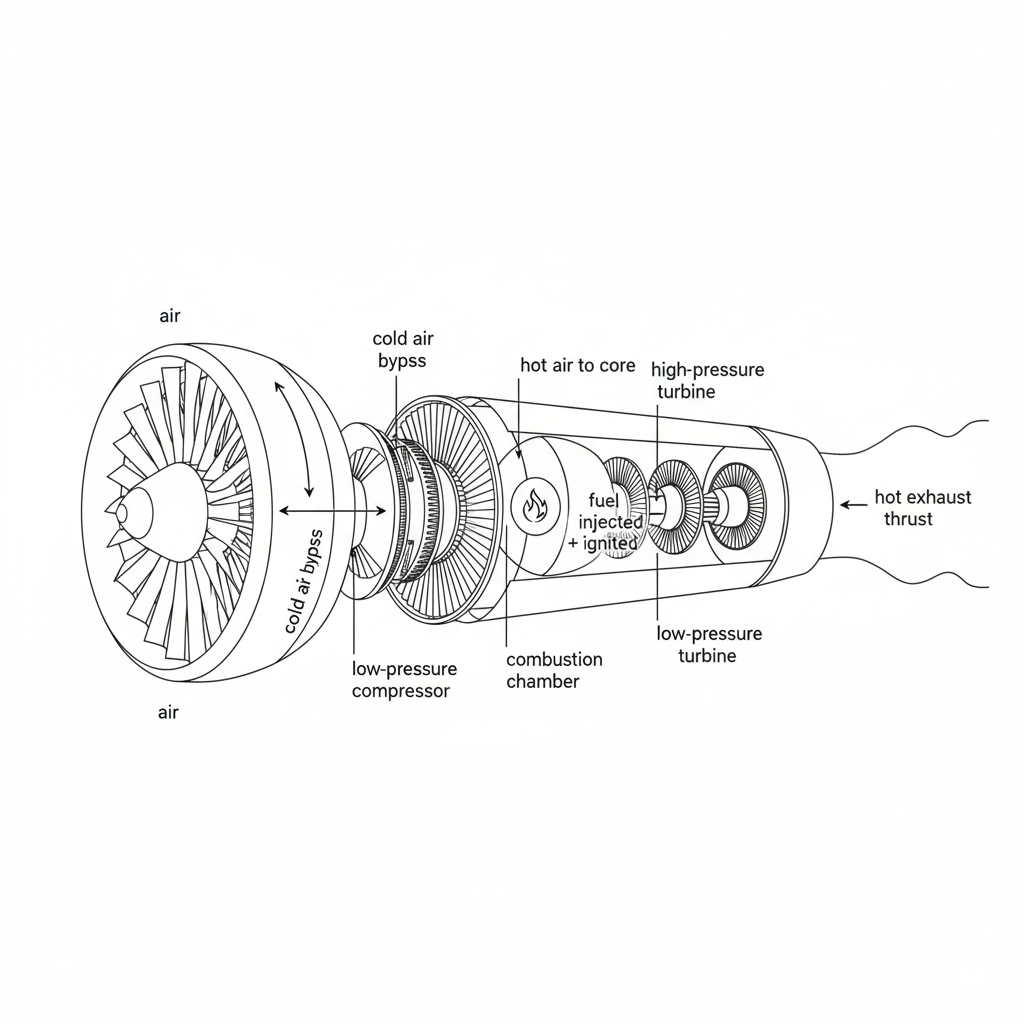
You can use AI (eg. NanoBanana on Gemini) to create storyboards to explain how things work. You can ask AI to annotate the images so you can identify components. This shortens the time it takes to generate images from text or thought (without the help of AI). In the long run this could be bad for one’s thinking process as you are not practicing image generation in your head and relying on an external source (i.e AI). Nevertheless AI can be helpful here if used responsibly for learning about things you may not have experienced as yet in real life or gathered knowledge about or experienced vicariously through hearing others experiences or watching videos, resulting in a lack of data from experience from which to draw from to generate these images mentally.
Below: NanoBanana generated image illustrating how a jet engine works: