Traditionally learning has been perceived as being linked to a physical space the classroom or at specific times like homework. It has been formalised. But what if learning was informal and happened all the time at every minute and could be used to achieve everyday goals rather than obtain certificates. What if you used your senses as research instruments to ask questions about things in your environment. Learning would be immediate and relevant to your current needs, this was how our ancestors learnt, they learnt to survive.
To realize your full potential, learning has to become a way of life, an obsession with knowing more about things both internally and externally. This curious mindset was apparent amongst thinkers throughout history. Leonardo da Vinci and Benjamin Franklin were both seen as autodidacts who taught themselves about things, asking why things were the way they were. Besides having a sharp eye for observing phenomena, they also built things to test their ideas by running informal experiments in the real-world.
Having a growth mindset allowed them to believe that IQ was not fixed and that knowledge could be created through specific methods and skills could be built through practice. Every experience is framed as an opportunity to learn something new and curious learners design their lives around learning through exposure to new environments, people and things. Learning is the lens through which they see the world.
Rather than seeing learning as located within formal institutions like a school, a university, following a pre-determined curriculum and being instructed by a teacher, learning is directed by the self allowing one to fully customise their learning to their interests and personal goals. You determine your goals for learning, you determine the curriculum and direct yourself through the learning process. To do this one needs to apply metacognition to stand outside one’s thoughts by taking a third person perspective and observing one’s own learning process to check for understanding and gaps in knowledge. This covered in more depth on the page ‘Metacognition.”
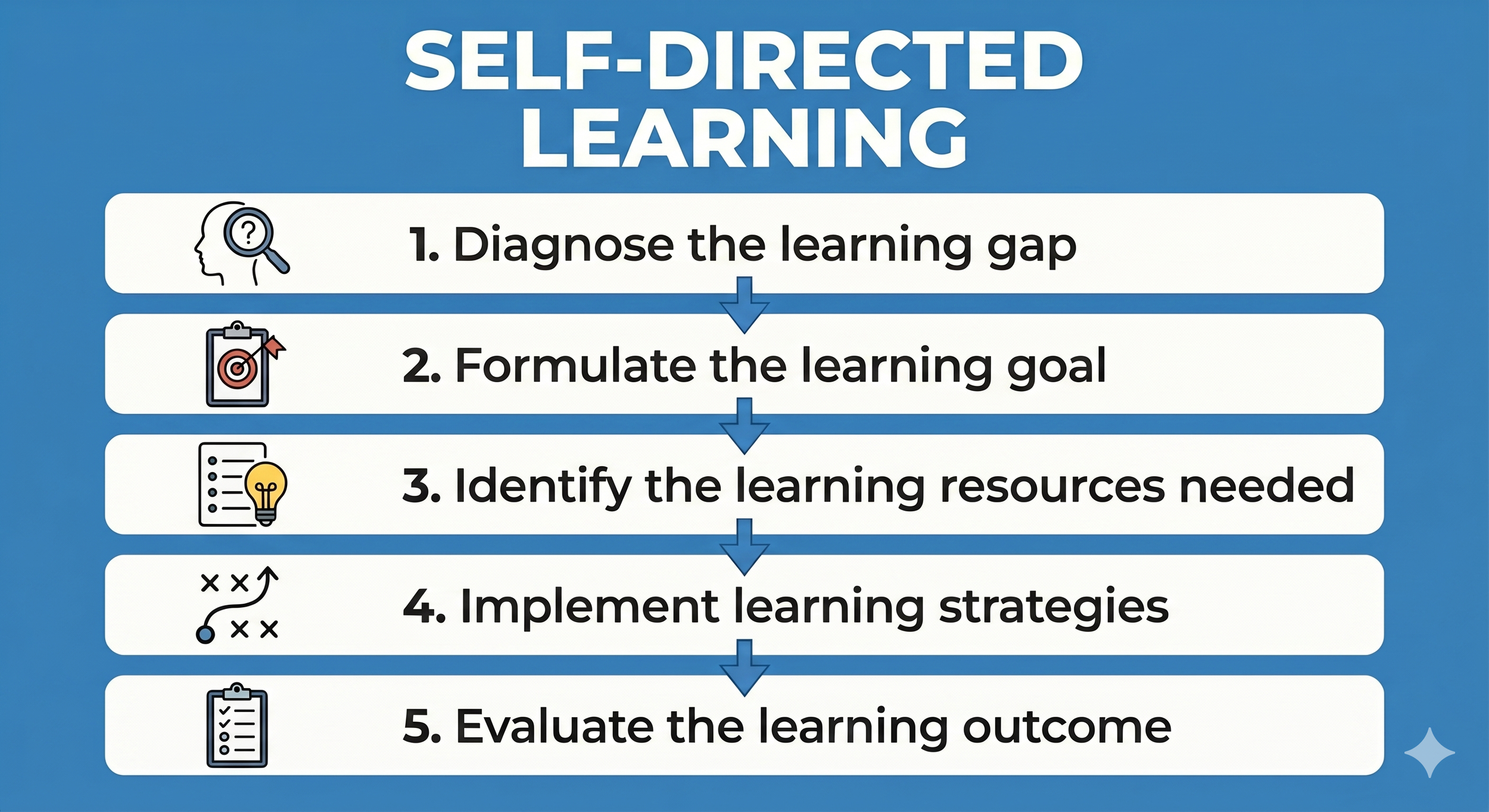
The self-directed learning framework can be used to direct one’s own learning. Learning resources refers to information like books, videos, podcasts or experiences. Learning strategies refer to methods for effectively consuming and understanding information eg. reflection, asking questions as you read to have a conversation with the author. This is covered in more depth on a later page.
It is important to understand one’s strengths and weaknesses as a learner, know what strategies to use to address areas needing improvement as well as what one’s preferences are when learning eg. consuming information through specific mediums like text, audio, video.
Question to consider when determining your learning profile:
What type of learner are you? Personality type
What topics give you energy? What do you enjoy doing?
What are your strengths and weaknesses?
What are your learning preferences in terms of types of content? Learning style
WHY? Identifying your interest and preferences will give your energy to learn and increase learning efficiency.
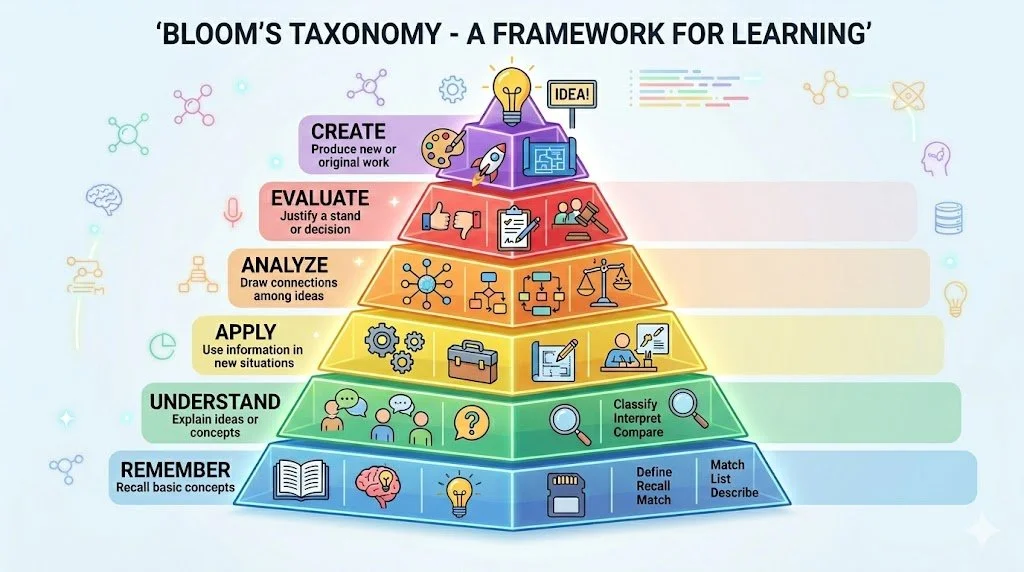
As you learn it is important to understand which level of the learning pyramid you are on. Usually we progress from the bottom up, starting by breaking down a complex topic into its key concepts. We then gain an understanding of the key concepts by obtaining definitions of them, gathering and consuming information on them and build understanding by comparing them to our past experiences to visualise them. Once we understand it we can apply the concept to solve a problem. Different steps in Blooms Taxonomy can be used at different times or simultaneously, there is not set sequence.